Your Pool Plaster Is Trying to Tell You Something
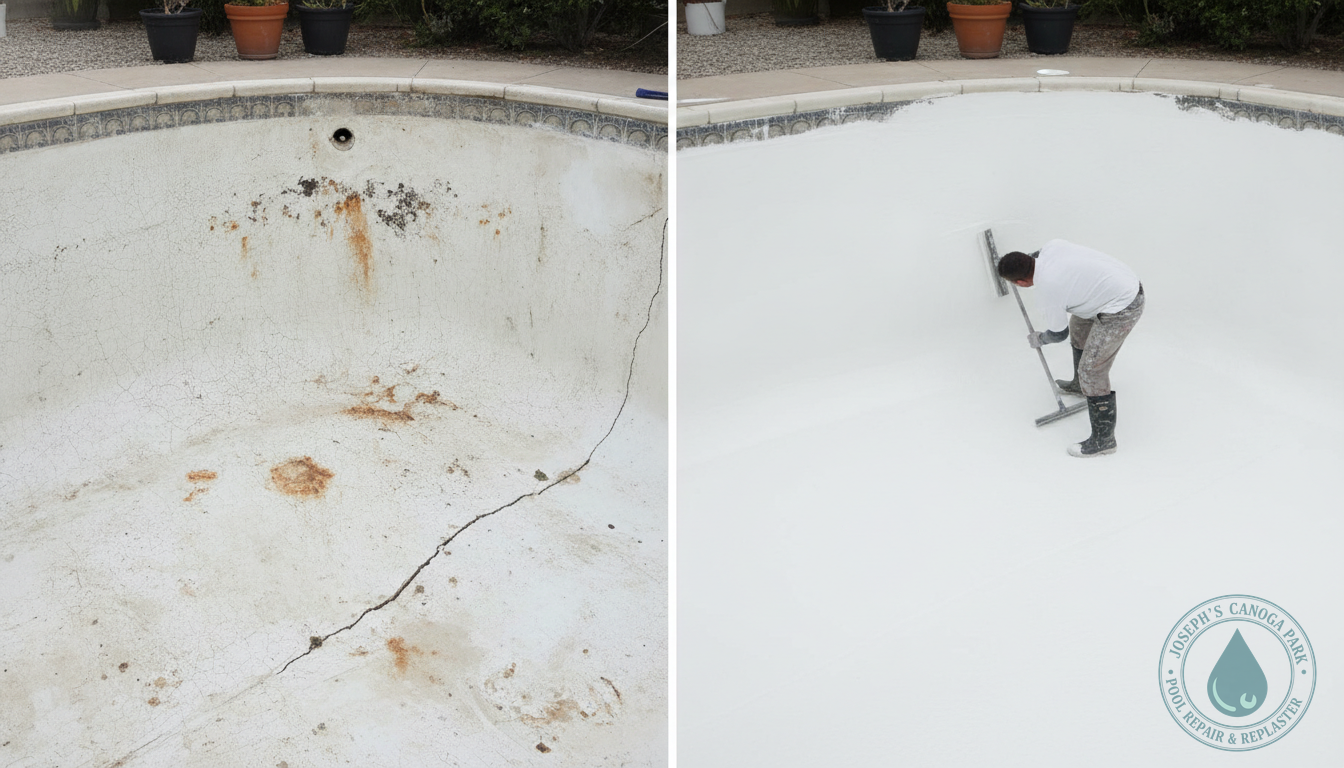
Pool plaster doesn't fail all at once. It sends signals — a rough texture underfoot, a chalky white residue that clouds the water, stains that won't respond to brushing or chemicals, or hairline cracks that gradually widen with each passing season. In Canoga Park and throughout the West San Fernando Valley, high UV exposure, year-round swimming, and the temperature swings between summer heat and cooler winter nights accelerate plaster deterioration faster than in more temperate climates. The average lifespan of standard white plaster in Southern California is 10 to 15 years — and many pools we inspect are pushing well past that before the owner schedules any surface work.
The question we hear most often is a practical one: Does my pool need a full replaster, or can I get away with patching the cracks? The honest answer depends on the extent and type of deterioration. At Joseph's Canoga Park Pool Repair & Replaster, we evaluate every pool individually before making a recommendation — because the wrong answer costs you money either way. A patch on a pool that needs a full replaster fails within a season. A full replaster on a pool that only needed crack repair is more expense than the situation required.
Signs That Targeted Crack Repair Is the Right Move
Not every crack is a crisis. Our pool crack repair service addresses specific failures in an otherwise sound plaster surface. Targeted repair makes sense when:
- The crack is isolated — one or two specific locations on an otherwise intact surface.
- The surrounding plaster is smooth, chemically balanced, and shows no widespread delamination or spalling.
- The pool is relatively young (under eight to ten years) and the plaster has not yet reached the end of its functional life.
- The crack is confirmed to be active (leaking) and requires immediate sealing to stop water loss before a full replaster is budgeted.
For isolated structural cracks — particularly those at the floor-to-wall transition, around main drains, or at the bond beam — epoxy or polyurethane injection stops water migration through the shell and stabilizes the failure point. Hydraulic cement packing combined with finish plaster patching handles the cosmetic restoration. We'll always discuss the expected appearance of the patch honestly: some color variation between the new patch and weathered surrounding plaster is normal, and we set that expectation clearly before the work begins.
Signs That a Full Replaster Is the Better Investment
There are situations where patching is simply throwing money at a surface that is past the point of no return. A full pool replastering is the right call when:
- Widespread crazing or checking: Fine cracks covering a large portion of the plaster surface indicate the finish layer has reached the end of its useful life. Patching individual cracks in a crazed surface is like putting tape on a cracked windshield — it doesn't address the underlying condition.
- Delamination or spalling: When sections of plaster are separating from the gunite substrate, the bond between the finish coat and the shell has failed. No surface patch will hold reliably over a delaminated substrate.
- Aggressive surface roughness: Plaster that has etched down to the aggregate and feels like sandpaper is not just uncomfortable — it's a sign of chemical erosion that has consumed the finish layer down to its structural limit.
- Chronic staining that won't clear: Mineral staining and algae that has penetrated deeply into deteriorated plaster often cannot be removed by acid washing alone. A fresh plaster surface eliminates the problem at its root.
- Multiple active leaks throughout the shell: When our pool leak detection process identifies water loss at numerous points in the plaster rather than a single isolated crack, replastering addresses all of them simultaneously instead of requiring individual patches across the entire pool.
What to Expect During the Replastering Process
A professional replaster job is a multi-step process, and the preparation work is just as important as the finish coat itself. At Joseph's, we don't apply new plaster over failed old plaster. Here's what our process looks like:
- Drain and substrate preparation: The pool is fully drained and the existing plaster is chipped out or bead-blasted down to the clean gunite substrate. Any delaminated material is removed completely.
- Shell inspection and crack repair: With the shell exposed, we inspect for structural cracks and address any active failures before the new finish goes on — this is the point where hidden structural issues are caught and corrected.
- Bonding slurry application: A bonding coat is applied to the prepared substrate to ensure proper adhesion between the old gunite and the new plaster.
- Finish coat application: Our experienced plasterers apply the finish coat in the timed sequence required to achieve uniform thickness and texture. Troweling technique matters — improper finishing creates the surface defects and early checking that lead to premature failure.
- Immediate refill and start-up chemistry: The pool is refilled immediately after plastering, and we walk every customer through the first-week water chemistry protocol. Proper start-up chemistry during the curing window is not optional — it's what separates a finish that lasts 15 years from one that begins showing problems in two.
Finish Options: White Plaster, Quartz, or Pebble?
Joseph's offers three finish categories for Canoga Park pool replastering projects:
- Standard white plaster: The most economical option. Provides the classic smooth, bright-white pool appearance. Best suited for budget-conscious projects where the pool will be well maintained chemically.
- Quartz aggregate: Crushed quartz crystals are blended into the plaster mix, adding stain resistance, improved durability, and a subtle texture. A good middle-ground option for pools that get heavy use.
- Pebble-style finishes: Small river pebbles create a natural, resort-style appearance and deliver the longest lifespan of the three options. The textured surface is easier to maintain aesthetically over time and hides minor chemical variations better than smooth white plaster.
We serve homeowners throughout Canoga Park and the surrounding area, including Tarzana, Reseda, and Chatsworth. If you're not sure which finish is right for your pool, budget, and usage patterns, we'll walk you through the trade-offs honestly during your estimate visit — no pressure, just clear information.
Get Your Pool Replastering Estimate Today
Whether you're dealing with a single stubborn crack or a pool surface that has finally reached the end of its life, Joseph's Canoga Park Pool Repair & Replaster can assess the situation and give you a straightforward recommendation. We're open Monday through Sunday, 8:00 AM to 6:00 PM.
Call us at +1 (747) 832-2275 or stop by 22048 Sherman Way, Suite 213, Canoga Park, CA 91303 to schedule your inspection and estimate. A new plaster surface isn't just cosmetic — it's the foundation of a leak-free, chemically stable, enjoyable pool for the next decade and beyond.