
The Leak You Can't See Is Often the Leak That Costs You the Most
When a pool light gasket fails or the pump lid O-ring cracks, the evidence is visible almost immediately — water at the equipment pad, a dye test that confirms the source within minutes. But when a PVC pipe buried two feet beneath your pool deck cracks from soil settlement or root intrusion, the evidence can stay hidden for months. The water migrates through the sub-base, follows the path of least resistance through the soil, and eventually surfaces somewhere entirely unrelated to the actual break — a soggy patch of lawn near the property line, efflorescence on a retaining wall, or water appearing under the slab of a nearby structure.
By the time the homeowner realizes something is wrong, the sub-base beneath the pool deck has been saturated for an extended period. Settled concrete, cracked coping, and erosion of the compacted base material beneath the deck are the downstream consequences of a plumbing leak that was never found. At Joseph's Canoga Park Pool Repair & Replaster, underground pool plumbing repair is one of the most technically demanding services we provide — and one of the most important for protecting the long-term structural integrity of your entire backyard.
Why Underground Pool Plumbing Fails in the West San Fernando Valley
The San Fernando Valley's geology and climate create a specific set of conditions that put buried pool plumbing under stress over time. Here are the most common failure mechanisms we see across Canoga Park, Winnetka, West Hills, Woodland Hills, and Chatsworth:
- Soil settlement and shifting: The Valley floor is composed of alluvial soils that can compact unevenly, particularly after heavy rainfall following dry periods. Differential settlement places lateral stress on buried PVC fittings and couplings — the points most likely to crack first.
- Root intrusion: Mature trees near pool decks are a significant cause of pipe displacement and cracking in established West Valley neighborhoods. Roots can grow into and around pipe runs, physically separating joints or crushing thinner-wall pipe sections.
- PVC age and UV degradation: Exterior PVC and fittings exposed to California sunlight at the equipment pad become brittle over time. Buried pipe is protected from UV but still has a finite service life, and pools built in the 1970s and 1980s — common in the Valley's older residential neighborhoods — may be running on original plumbing that is 40 or more years old.
- Improper original installation: Pipe runs that weren't bedded in clean sand or that were glued improperly at the time of installation can fail at joints decades later when the joint compound degrades.
Recognizing the Warning Signs of a Buried Plumbing Leak
Because the leak itself is underground and invisible, homeowners have to read indirect symptoms to recognize a plumbing problem. Be alert to these indicators:
- Water loss that changes with pump operation: A pool that drops when the pump is running but holds steady when the pump is off points toward a pressure-side leak (return lines). A pool that drops only when the pump is off, or drops at the same rate regardless of pump operation, is more consistent with a structural or suction-side issue.
- Soft or sunken areas on the pool deck: If sections of your concrete deck feel soft underfoot or have visibly dropped relative to adjacent sections, the sub-base may be saturated and eroding.
- Unexplained wet spots in the yard: Water appearing in landscaping or lawn areas that have no direct irrigation or rainfall explanation — particularly near the pool's plumbing runs — is a classic sign of a buried pipe leak.
- Dramatically increased chemical demand: A pool that requires far more chlorine and pH adjustment than it used to may be losing water (and the chemicals dissolved in it) faster than normal, diluting the chemistry with fresh fill water.
- Air bubbles returning through jets: Bubbles visible at the return jets while the pump is running indicate that air is being drawn into the suction side of the system — potentially through a crack in a suction line or a loose fitting above or below ground.
How We Find the Leak Without Tearing Up Your Deck
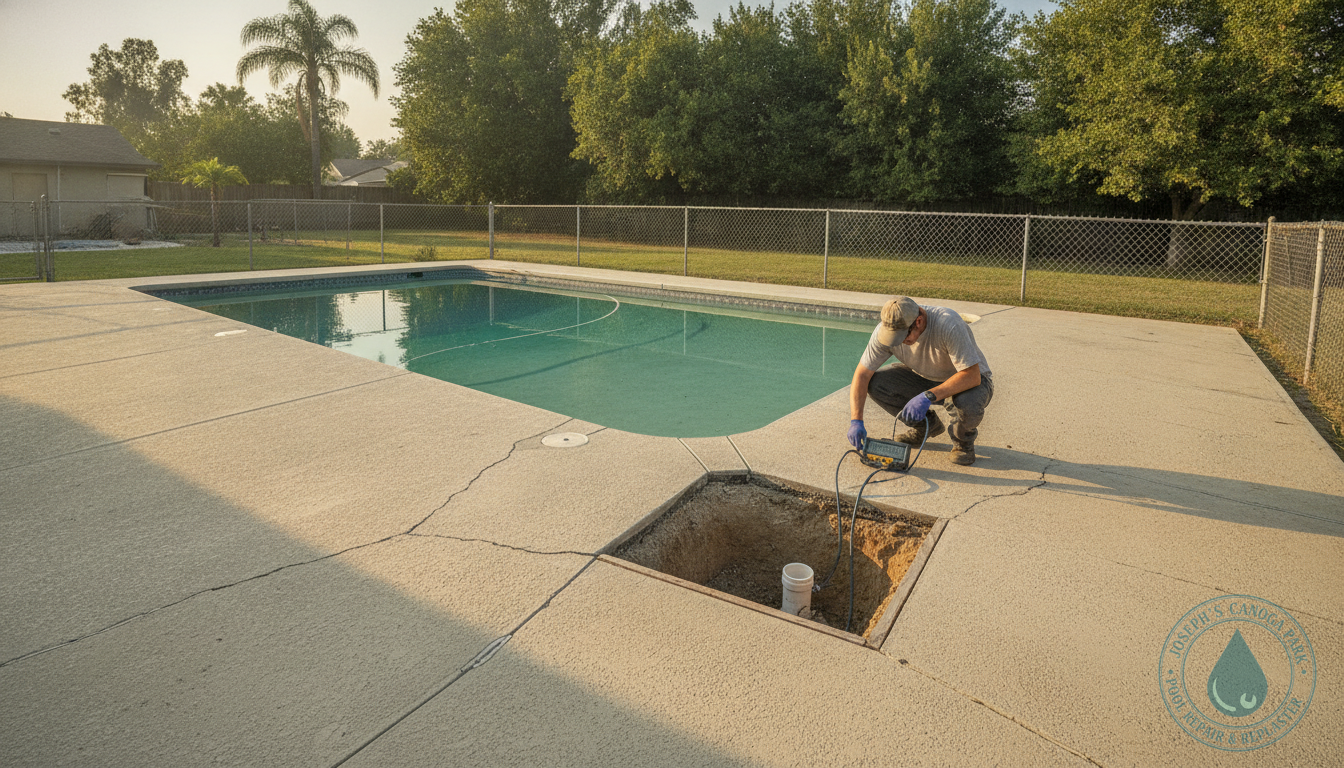
The defining feature of professional underground plumbing leak detection is that a confident diagnosis is reached before any concrete is disturbed. Our process starts with a full pool leak detection evaluation and then moves into plumbing-specific pressure isolation:
- Each plumbing circuit — main drain, skimmer suction, return lines, and any auxiliary lines — is isolated by plugging the fitting at the pool wall and pressurizing the pipe from the equipment pad.
- A digital pressure gauge monitors each line over a set interval. A line that holds pressure is intact. A line that loses pressure has a breach somewhere in its run.
- Once the failing line is confirmed, we use the pressure decay pattern, the pool's hydraulic layout, and in some cases electronic acoustic equipment to narrow the leak location to the smallest possible section of the pipe run.
- Only then — with a confirmed leak location — do we cut concrete. We core-cut or saw-cut a precise opening directly above the failure point, make the repair, and retest before closing the opening.
This process prevents the expensive and destructive scenario where concrete is removed speculatively in multiple locations before the leak is actually found. Our customers in Reseda and Tarzana appreciate that we treat their deck as something to be protected, not a surface to excavate first and ask questions later.
Repair Options: Spot Repair, Pipe Lining, and Re-Routing
Once the leak location is confirmed, the repair approach depends on the nature and extent of the failure:
- Spot excavation and coupling: For a single cracked pipe section or failed fitting, we excavate directly to the failure, cut out the damaged section, and install a new coupling or fitting. The repair area is backfilled and the concrete surface is restored. This is the most common repair scenario.
- Pipe re-routing: Where the failed pipe runs beneath a structure that makes excavation impractical — a concrete deck addition, a raised spa, or a pergola foundation — re-routing the line above or around the obstruction may be the most practical solution.
- Pipe lining evaluation: In some situations where a long pipe run has multiple small failures and full excavation would be highly disruptive, pipe lining options can be evaluated as an alternative. We discuss this openly when the specific conditions make it appropriate.
After any plumbing repair, we retest the repaired circuit at full pressure before closing the excavation to confirm zero pressure loss. There's no guessing — the gauge tells us definitively whether the repair is complete.
Don't Wait — Underground Leaks Get Worse, Not Better
A cracked PVC pipe doesn't seal itself. Every day the leak continues, more water saturates the sub-base, more soil erodes from beneath your deck, and the structural consequences of the leak compound. The cost of repairing a pool deck that has settled due to years of sub-base erosion far exceeds the cost of a timely plumbing repair.
Joseph's Canoga Park Pool Repair & Replaster is available seven days a week, 8:00 AM to 6:00 PM. We serve Canoga Park and the entire West San Fernando Valley with same-week appointments for plumbing leak diagnosis. If our inspection reveals that your plumbing is sound and the water loss is coming from the pool shell or equipment, our crack repair, light niche repair, and equipment pad repair services complete the picture.
Call us at +1 (747) 832-2275 or visit 22048 Sherman Way, Suite 213, Canoga Park, CA 91303 to schedule your plumbing inspection. The sooner we find it, the less it costs to fix it.