
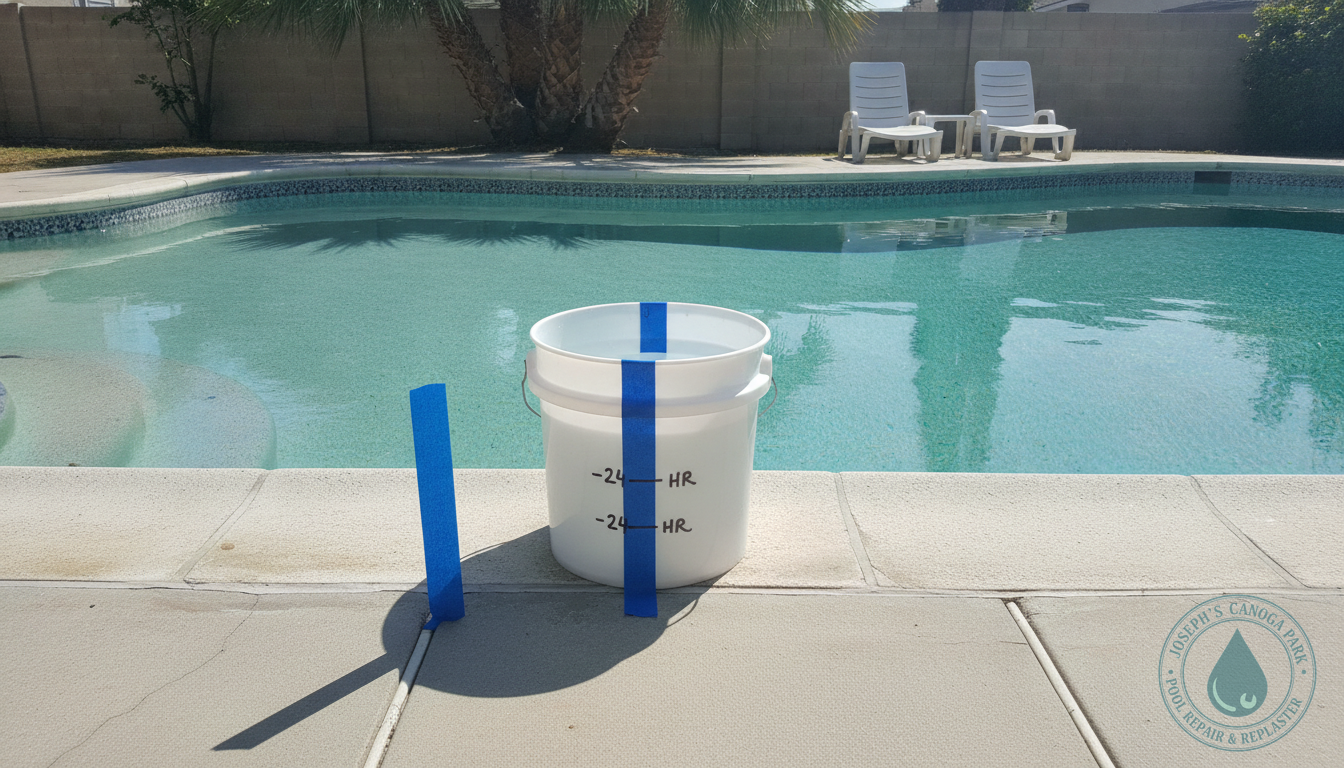
Is Your Pool Water Level Dropping — or Is It Just Evaporation?
For most Canoga Park homeowners, the first sign of a pool leak isn't a dramatic crack or a gushing pipe — it's a slow, nagging drop in the water level that seems just a little too fast to blame entirely on the summer heat. With temperatures regularly climbing above 90°F in the West San Fernando Valley, evaporation is real and significant. But evaporation alone typically accounts for about a quarter-inch of water loss per day in Southern California. If your pool is dropping a half-inch, three-quarters of an inch, or more over 24 hours, you may well have a leak that deserves professional attention.
At Joseph's Canoga Park Pool Repair & Replaster, we get calls every week from homeowners who have been adding water for months, assuming the loss was normal, only to learn that a hidden leak has been silently saturating the soil beneath their deck, destabilizing their coping, and running up their water bill the entire time. The sooner a leak is identified, the less damage it causes — and the less it costs to repair.
The Bucket Test: Your First DIY Diagnostic Step
Before calling anyone, you can perform a simple and reliable test at home to confirm whether your pool is actually losing water beyond what evaporation would explain. Here's how:
- Fill a five-gallon bucket with pool water and set it on the first or second pool step so it sits at the same water level as the pool surface.
- Mark the water level inside the bucket and the pool water level on the pool wall with a piece of tape or a grease pencil.
- Turn off your pool pump and auto-fill valve and leave the pool undisturbed for 24 hours.
- After 24 hours, compare the drop in the bucket to the drop in the pool. Both should lose roughly the same amount to evaporation. If the pool has dropped significantly more than the bucket, you have a leak.
This test won't tell you where the leak is, but it confirms that one exists and gives you solid information before you call for professional pool leak detection.
Common Causes of Pool Water Loss in Canoga Park
Once a leak is confirmed, the next question is always: where is it coming from? In our experience serving Canoga Park and surrounding communities like Winnetka, Woodland Hills, and West Hills, the most common leak sources fall into a handful of categories.
1. Shell Cracks — Surface and Structural
Pool plaster and the underlying gunite or shotcrete shell are subject to thermal expansion and contraction, soil movement, and simply aging. Hairline cracks in the plaster layer are common and don't always indicate a through-shell leak, but cracks that run along the floor-to-wall transition, circle the main drain, or are wider than a credit card's thickness deserve immediate inspection. Our pool crack repair service evaluates every crack to determine whether it's cosmetic or actively losing water, and we repair it using the method appropriate to its severity — hydraulic cement packing, epoxy injection, or plaster patching.
2. Leaking Pool Light Niche
The gasket between the pool light's face ring and the niche housing is one of the most frequently missed leak sources we find. Water can migrate around a deteriorated gasket continuously, and the conduit that carries the light's wiring through the pool wall can also allow water to escape if its seal fails. A leaking niche can lose several inches of water per day. Our pool light seal and niche repair service uses dye testing to confirm niche leaks before any work is performed, so you're never paying to fix something that isn't broken.
3. Underground Plumbing Failures
PVC pipes buried beneath pool decks and landscaping can crack from soil settlement, root intrusion, or age-related brittleness. These leaks are particularly insidious because the water loss often shows up far from the actual break — soggy patches in the lawn, water appearing near the foundation, or a pool that drops only when the pump is running (which points to a return line) or only when the pump is off (which points to a suction-side or structural leak). Our pool plumbing repair team pressure-tests each plumbing circuit individually to confirm exactly which line is failing before any concrete is cut.
4. Equipment Pad Leaks
Pump lid O-rings, filter multiport valve gaskets, union fittings, and flexible PVC connections at the equipment pad all degrade over time in Southern California's UV-intense, high-temperature climate. A dripping union fitting or a cracked pump lid isn't just an annoyance — it saturates the soil beneath your equipment pad and can ultimately damage expensive pump motors through water intrusion. Our pool equipment repair service covers every component on the pad, from O-rings and shaft seals to rigid PVC elbows and flex hose connections.
What Happens If You Ignore a Pool Leak?
A pool that loses even a quarter-inch of water per day beyond normal evaporation is losing roughly 150 to 200 gallons a week for a standard residential pool. Over a Los Angeles summer, that's thousands of gallons — and in California's water-pricing environment, that adds up to hundreds of dollars on your utility bill before you've accounted for the chemicals you're also losing with every inch of water that escapes.
Beyond the water bill, the saturated soil beneath your deck is gradually undermining the concrete slab, your coping, and potentially the structural integrity of the pool shell itself. We've seen decks that settled several inches and coping stones that shifted dangerously — all because a slow leak went unaddressed for two or three seasons.
Schedule a Leak Detection Inspection This Week
Joseph's Canoga Park Pool Repair & Replaster uses pressure testing, dye testing, and electronic acoustic listening equipment to locate leaks in the shell, plumbing, light niches, and equipment pad — systematically and without unnecessary excavation. We're available Monday through Sunday, 8:00 AM to 6:00 PM, and we can typically schedule same-week appointments for Canoga Park homeowners and neighbors throughout the West Valley.
Call us at +1 (747) 832-2275 or visit our office at 22048 Sherman Way, Suite 213, Canoga Park, CA 91303 to book your inspection. The sooner you know, the less it costs to fix — and the sooner you can stop watching your water level drop.